We've seen a few functions that "return" any type
undefined :: a
error :: String -> aThese functions throw language-level exceptions
Control.Exception as follows:import Prelude hiding (catch) -- not necessary with new GHCs
import Control.ExceptionOlder Preludes have an old, less general version of catch you should avoid (hiding keyword prevents import of specific symbols)
Control.Exception gives you access to the following symbols:
class (Typeable e, Show e) => Exception e where ...
throw :: Exception e => e -> a
throwIO :: Exception e => e -> IO a
catch :: Exception e => IO a -> (e -> IO a) -> IO a{-# LANGUAGE DeriveDataTypeable #-}
import Prelude hiding (catch)
import Control.Exception
import Data.Typeable
data MyError = MyError String deriving (Show, Typeable)
instance Exception MyError
catcher :: IO a -> IO (Maybe a)
catcher action = fmap Just action `catch` handler
where handler (MyError msg) = do putStrLn msg; return Nothing*Main> catcher $ readFile "/dev/null"
Just ""
*Main> catcher $ throwIO $ MyError "something bad"
something bad
NothingDeriveDataTypeable language pragma (later lecture)handler's type cannot be inferred (use constructor or type signature)
e@(SomeException _) catches all exceptionscatcher around an IO actionthrow exceptions in pure code, yet catch them only in IO
(error "one") + (error "two")?catch is restricted to the IO MonadIn IO, use throwIO (not throw) to make exception sequencing precise
    do x <- throwIO (MyError "one")  -- this exception thrown
       y <- throwIO (MyError "two")  -- this code not reached
return $ x + ythrow only where you can't use throwIOPure exceptions quite useful for errors & unimplemented code, E.g.:
-- Simplified version of functions in standard Prelude:
error :: String -> a
error a = throw (ErrorCall a)
undefined :: a
undefined = error "Prelude.undefined"Consider the following function
pureCatcher :: a -> IO (Maybe a)
pureCatcher a = (a `seq` return (Just a))
                `catch` \(SomeException _) -> return Nothing
pureCatcher $ 1 + 1
Just 2
*Main> pureCatcher $ 1 `div` 0
Nothing
*Main> pureCatcher (undefined :: String)
NothingWhat happens if you do this?
*Main> pureCatcher (undefined:undefined :: String)Consider the following function
pureCatcher :: a -> IO (Maybe a)
pureCatcher a = (a `seq` return (Just a))
                `catch` \(SomeException _) -> return Nothing
pureCatcher $ 1 + 1
Just 2
*Main> pureCatcher $ 1 `div` 0
Nothing
*Main> pureCatcher (undefined :: String)
NothingWhat happens if you do this?
*Main> pureCatcher (undefined:undefined :: String)
Just "*** Exception: Prelude.undefinedConsider the following function
pureCatcher :: a -> IO (Maybe a)
pureCatcher a = (a `seq` return (Just a))
                `catch` \(SomeException _) -> return Nothing
pureCatcher $ 1 + 1
Just 2
*Main> pureCatcher $ 1 `div` 0
Nothing
*Main> pureCatcher (undefined :: String)
NothingWhat happens if you do this?
*Main> pureCatcher (undefined:undefined :: String)
Just "*** Exception: Prelude.undefined
catch only catches exceptions when thunks actually evaluated!
Evaluating a list does not evaluate the head or tail
*Main> seq (undefined:undefined) ()
()(:) or [])Exercise: Force evaluation of every element of a list
seq-like function with the following signature, that evaluates every element of list before evaluating second argumentseqList :: [a] -> b -> b*Main> seqList [1, 2, 3] ()
()
*Main> seqList [1, 2, 3, undefined] ()
*** Exception: Prelude.undefinedseqList :: [a] -> b -> b
seqList [] b = b
seqList (a:as) b = seq a $ seqList as bdeepseq in library of same name that does this for many common data typestry returns Right a normally, Left e if an exception occurred
try :: Exception e => IO a -> IO (Either e a)finally and onException run an clean-up action
finally :: IO a -> IO b -> IO a      -- cleanup always
onException :: IO a -> IO b -> IO a -- after exceptionb) is discardedcatchJust catches only exceptions matching a predicate on value
catchJust :: Exception e =>
             (e -> Maybe b) -> IO a -> (b -> IO a) -> IO a

readFileIfExists f = catchJust p (readFile f) (\_ -> return "")
  where p e = if isDoesNotExistError e then Just e else Nothing
*Main> readFileIfExists "/nosuchfile"
""
*Main> readFileIfExists "/etc/shadow"
*** Exception: /etc/shadow: openFile: permission denied ...IO actions
IO monadIO also can't catch exceptionsMaybe Monad, where can use Nothing to indicate failureinstance Monad Maybe where
(Just x) >>= k = k x
Nothing >>= _ = Nothing
return = Just
fail _ = Nothingfail method called when bind pattern matches fail in do block*Main> (do 1 <- return 2; return 3) :: Maybe Int
NothingHaskell implements user-level threads in Control.Concurrent
forkIO call creates a new thread:
forkIO :: IO () -> IO ThreadId -- creates a new threadA few other very useful thread functions:
throwTo :: Exception e => ThreadId -> e -> IO ()
killThread :: ThreadId -> IO ()   -- = flip throwTo ThreadKilled
threadDelay :: Int -> IO ()       -- sleeps for # of µsec
myThreadId :: IO ThreadIdIO action, or abort after # of µsec
System.Timeout has a slightly better version of this functiondata TimedOut = TimedOut UTCTime deriving (Eq, Show, Typeable)
instance Exception TimedOut
timeout :: Int -> IO a -> IO (Maybe a)
timeout usec action = do
-- Create unique exception val (for nested timeouts):
expired <- fmap TimedOut getCurrentTime
ptid <- myThreadId
let child = do threadDelay usec
throwTo ptid expired
parent = do ctid <- forkIO child
result <- action
killThread ctid
return $ Just result
catchJust (\e -> if e == expired then Just e else Nothing)
parent
(\_ -> return Nothing)MVarsThe MVar type lets threads communicate via shared variables
MVar t is a mutable variable of type t that is either full or emptynewEmptyMVar :: IO (MVar a) -- create empty MVar
newMVar :: a -> IO (MVar a) -- create full MVar given val
takeMVar :: MVar a -> IO a
putMVar :: MVar a -> a -> IO ()MVar is full, takeMVar makes it empty and returns former contentsMVar is empty, putMVar fills it with a valueMVar or putting a full one puts thread to sleep until MVar becomes availableMVarMVar callstryTakeMVar :: MVar a -> IO (Maybe a) -- Nothing if empty
tryPutMVar :: MVar a -> a -> IO Bool -- False if fullimport Control.Concurrent
import Control.Exception
import Control.Monad
pingpong :: Bool -> Int -> IO ()
pingpong v n = do
mvc <- newEmptyMVar -- MVar read by child
mvp <- newEmptyMVar -- MVar read by parent
let parent n | n > 0 = do when v $ putStr $ " " ++ show n
putMVar mvc n
takeMVar mvp >>= parent
| otherwise = return ()
child = do n <- takeMVar mvc
putMVar mvp (n - 1)
child
tid <- forkIO child
parent n `finally` killThread tid
when v $ putStrLn ""*Main> pingpong True 10
10 9 8 7 6 5 4 3 2 1import Criterion.Main
...
main :: IO ()
main = defaultMain [
bench "thread switch test" mybench
]
where mybench = pingpong False 10000$ ghc -O pingpong.hs
[1 of 1] Compiling Main ( pingpong.hs, pingpong.o )
Linking pingpong ...
$ ./pingpong
...
benchmarking thread switch test
mean: 3.774590 ms, lb 3.739223 ms, ub 3.808865 ms, ci 0.950
...-threaded to allow OS threads (pthread_create) as wellforkOS call creates Haskell thread bound to a new OS thread
forkOS :: IO () -> IO ThreadId-threaded, initial thread is boundWhoa... what happened? -threaded 30 times slower?
$ rm pingpong
$ ghc -threaded -O pingpong.hs
Linking pingpong ...
$ ./pingpong
...
mean: 121.1729 ms, lb 120.5601 ms, ub 121.7044 ms, ci 0.950
...-threaded, all Haskell threads run in one OS thread
-threaded introduces multiple OS-level threads
unbound haskell threads have same performance as w/o -threadedforkIO to make it unboundwrap :: IO a -> IO a
wrap action = do
mv <- newEmptyMVar
_ <- forkIO $ (action >>= putMVar mv) `catch`
\e@(SomeException _) -> putMVar mv (throw e)
takeMVar mvrunInUnboundThreadsafe and unsafe-threaded, GHC ensures safe FFI calls run in separate OS threadunsafe FFI calls from unbound threads can block other threadspthread_getspecific can get confused if called from a migrated unbound threadforkOnSome handy MVar utility functions for updating a value
modifyMVar :: MVar a -> (a -> IO (a, b)) -> IO b
modifyMVar_ :: MVar a -> (a -> IO a) -> IO ()modifyMVar x (\n -> return (n+1, n))" like "x++" in CHow would you implement modifyMVar?
modifyMVar :: MVar a -> (a -> IO (a,b)) -> IO b
modifyMVar m action = do
  v0 <- takeMVar m
  (v, r) <- action v0 `onException` putMVar m v0
  putMVar m v
return rthrowTo, killThread)Some handy MVar utility functions for updating a value
modifyMVar :: MVar a -> (a -> IO (a, b)) -> IO b
modifyMVar_ :: MVar a -> (a -> IO a) -> IO ()modifyMVar x (\n -> return (n+1, n))" like "x++" in CHow would you implement modifyMVar?
modifyMVar :: MVar a -> (a -> IO (a,b)) -> IO b
modifyMVar m action = do
  v0 <- takeMVar m -- -------------- oops, race condition
  (v, r) <- action v0 `onException` putMVar m v0
  putMVar m v
return rkillThread on the current thread while current thread between takeMVar and onExceptiontimeout and wrap functions from a few slides ago have same problemThe mask function can sidestep such race conditions
mask :: ((forall a. IO a -> IO a) -> IO b) -> IO bRankNTypes. For now, ignore "forall a."--just makes function more flexiblemask $ \f -> b runs action b with asynchronous exceptions maskedf allows exceptions to be unmasked again for an actiontakeMVar)Example: Fixing modifyMVar
modifyMVar :: MVar a -> (a -> IO (a,b)) -> IO b
modifyMVar m action = mask $ \unmask -> do
  v0 <- takeMVar m -- automatically unmasked while waiting
  (v, r) <- unmask (action v0) `onException` putMVar m v0
  putMVar m v
return rforkIO preserves the current mask state
unmask function in child threadwrap functionwrap :: IO a -> IO a -- Fixed version of wrap
wrap action = do
mv <- newEmptyMVar
mask $ \unmask -> do
tid <- forkIO $ (unmask action >>= putMVar mv) `catch`
\e@(SomeException _) -> putMVar mv (throw e)
let loop = takeMVar mv `catch` \e@(SomeException _) ->
throwTo tid e >> loop
loopunmask in parent thread
loop will sleep on takeMVar, which implicitly unmasksbracket functionmask is tricky, but library function bracket simplifies use
bracket :: IO a -> (a -> IO b) -> (a -> IO c) -> IO cExample: process file without leaking handle
bracket (openFile "/etc/mtab" ReadMode) -- first
        hClose                          -- last
        (\h -> hGetContents h >>= doit) -- main
Example: fix parent function from our timeout example
  parent = do ctid <- forkIO child             -- old code,
              result <- action                 -- bad if async
              killThread ctid                  -- exception
              return $ Just result
parent = bracket (forkIO child) killThread $ -- new code
\_ -> fmap Just actionMVarsMVars work just fine as a mutex:
-- type introduces type alias (like typedef in C)
type Mutex = MVar ()

mutex_create :: IO Mutex
mutex_create = newMVar ()

mutex_lock, mutex_unlock :: Mutex -> IO ()
mutex_lock = takeMVar
mutex_unlock mv = putMVar mv ()

mutex_synchronize :: Mutex -> IO a -> IO a
mutex_synchronize mv action =
    bracket (mutex_lock mv) (\_ -> mutex_unlock mv)
(\_ -> action)Mutex if it is locked
MutexUse full MVar rather than empty to mean lock held
type Mutex = MVar ThreadId

mutex_create :: IO Mutex
mutex_create = newEmptyMVar

mutex_lock, mutex_unlock :: Mutex -> IO ()

mutex_lock mv = myThreadId >>= putMVar mv

mutex_unlock mv = do mytid <- myThreadId
                     lockTid <- tryTakeMVar mv
                     unless (lockTid == Just mytid) $
error "mutex_unlock"ThreadId of lock owner in MVarmask for this question...data Cond = Cond (MVar [MVar ()])
cond_create :: IO Cond
cond_create = liftM Cond $ newMVar []
-- liftM is fmap for Monads (i.e., no required Functor instance):
-- liftM f m1 = do x <- m1; return (f m1)
cond_wait :: Mutex -> Cond -> IO ()
cond_wait m (Cond waiters) = do
me <- newEmptyMVar
modifyMVar_ waiters $ \others -> return $ others ++ [me]
mutex_unlock m -- note we don't care if preempted after this
takeMVar me `finally` mutex_lock m
cond_signal, cond_broadcast :: Cond -> IO ()
cond_signal (Cond waiters) = modifyMVar_ waiters wakeone
where wakeone [] = return []
wakeone (w:ws) = putMVar w () >> return ws
cond_broadcast (Cond waiters) = modifyMVar_ waiters wakeall
where wakeall ws = do mapM_ (flip putMVar ()) ws
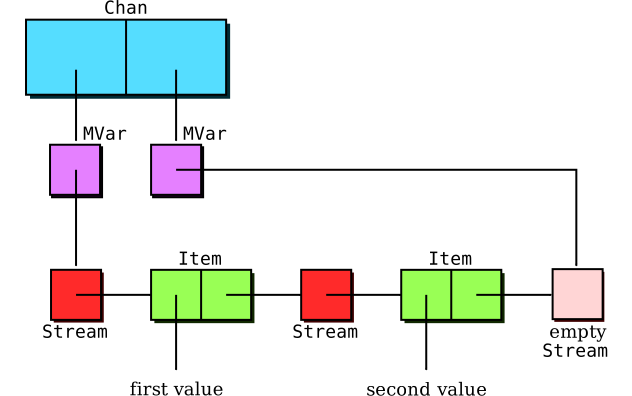
return []MVars inside MVars is very powerfulControl.Concurrent.Chan provides unbounded channels
MVars -- for read and and write end of Streamdata Item a = Item a (Stream a)
type Stream a = MVar (Item a)
data Chan a = Chan (MVar (Stream a)) (MVar (Stream a))data Item a = Item a (Stream a)
type Stream a = MVar (Item a)
data Chan a = Chan (MVar (Stream a)) (MVar (Stream a))
newChan :: IO (Chan a)
newChan = do
empty <- newEmptyMVar
liftM2 Chan (newMVar empty) (newMVar empty)
-- liftM2 is like liftM for functions of two arguments:
-- liftM2 f m1 m2 = do x1 <- m1; x2 <- m2; return (f x1 x2)
writeChan :: Chan a -> a -> IO ()
writeChan (Chan _ w) a = do
empty <- newEmptyMVar
modifyMVar_ w $ \oldEmpty -> do
putMVar oldEmpty (Item a empty)
return empty
readChan :: Chan a -> IO a
readChan (Chan r _) =
modifyMVar r $ \full -> do
(Item a newFull) <- takeMVar full
return (newFull, a)High-level Stream (TCP & Unix-domain) socket support in Network
connectTo :: HostName -> PortID -> IO Handle
listenOn :: PortID -> IO Socket
accept :: Socket -> (Handle, HostName, PortNumber)
sClose :: Socket -> IO ()
hClose :: Handle -> IO ()
Exercise: Network-enabled rock-paper-scissors. Define:
withClient :: PortID -> (Handle -> IO a) -> IO aThis accepts connection, plays single game, exits
*Main> withClient (PortNumber 1617) (computerVsUser Rock)$ nc localhost 1617
Please enter one of [Rock,Paper,Scissors]
Rock
You TieStart with last week's code: wget cs240h.stanford.edu/rock2.hs
withClient :: PortID -> (Handle -> IO a) -> IO a
withClient listenPort fn =
  bracket (listenOn listenPort) sClose $ \s -> do
    bracket (accept s) (\(h, _, _) -> hClose h) $
      \(h, host, port) -> do
        putStrLn $ "Connection from host " ++ host
                   ++ " port " ++ show port
fn hBuild a program netrock that plays two users against one another and exits after one game
$ nc localhost 1617
Please enter one of [Rock,Paper,Scissors]
Rock
You Win
$ nc localhost 1617
Please enter one of [Rock,Paper,Scissors]
Scissors
You LoseStart here: wget cs240h.stanford.edu/netrock.hs, implement:
netrock :: PortID -> IO ()You may find it useful to define and use:
play :: MVar Move -> MVar Move
     -> (Handle, HostName, PortNumber) -> IO ()
play myMoveMVar opponentMoveMVar (h, host, port) = do
If your OS is missing nc: wget cs240h.stanford.edu/netcat.hs
play :: MVar Move -> MVar Move
     -> (Handle, HostName, PortNumber) -> IO ()
play myMoveMVar opponentMoveMVar (h, host, port) = do
  putStrLn $ "Connection from host " ++ host ++ " port " ++ show port
  myMove <- getMove h
  putMVar myMoveMVar myMove
  opponentMove <- takeMVar opponentMoveMVar
  let o = outcome myMove opponentMove
  hPutStrLn h $ "You " ++ show o

netrock :: PortID -> IO ()
netrock listenPort =
  bracket (listenOn listenPort) sClose $ \s -> do
    mv1 <- newEmptyMVar
    mv2 <- newEmptyMVar
    let cleanup mv (h,_,_) = do
          tryPutMVar mv (error "something blew up")
          hClose h
    wait <- newEmptyMVar
    forkIO $ bracket (accept s) (cleanup mv1) (play mv1 mv2)
      `finally` putMVar wait ()
    bracket (accept s) (cleanup mv2) (play mv2 mv1)
takeMVar waitAlso have low-level BSD socket support in Network.Socket
socket :: Family -> SocketType -> ProtocolNumber -> IO Socket
connect :: Socket -> SockAddr -> IO ()
bindSocket :: Socket -> SockAddr -> IO ()
listen :: Socket -> Int -> IO ()
accept :: Socket -> IO (Socket, SockAddr)
getAddrInfo looks up hostnames just like [RFC3493] (returns [AddrInfo])getAddrInfo :: Maybe AddrInfo
-> Maybe HostName -> Maybe ServiceName
-> IO [AddrInfo]SockAddr for talking to web server:webServerAddr :: String -> IO SockAddr
webServerAddr name = do
addrs <- getAddrInfo Nothing (Just name) (Just "www")
return $ addrAddress $ head $ addrsnetcat :: String -> String -> IO ()
netcat host port = do
-- Extract address from first AddrInfo in list
AddrInfo{ addrAddress = addr, addrFamily = family }:_
<- getAddrInfo Nothing (Just host) (Just port)
-- Create a TCP socket connected to server
s <- socket family Stream 0
connect s addr
-- Convert socket to handle
h <- socketToHandle s ReadWriteMode
hSetBuffering h NoBuffering -- THIS IS IMPORTANT
-- Punt on complex locale stuff
hSetBinaryMode stdout True
-- Copy data back and forth taking advantage of laziness
done <- newEmptyMVar
forkIO $ (hGetContents h >>= putStr) `finally` putMVar done ()
getContents >>= hPutStr h
takeMVar done