Transpose vectors (secondary)
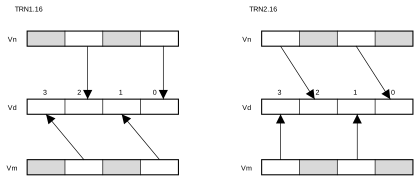
This instruction reads corresponding odd-numbered vector elements from the two source SIMD&FP registers, places each result into consecutive elements of a vector, and writes the vector to the destination SIMD&FP register. Vector elements from the first source register are placed into even-numbered elements of the destination vector, starting at zero, while vector elements from the second source register are placed into odd-numbered elements of the destination vector.
By using this instruction with TRN1, a 2 x 2 matrix can be transposed.
The following figure shows an example of the operation of TRN1 and TRN2 halfword operations where Q = 0.
Depending on the settings in the CPACR_EL1, CPTR_EL2, and CPTR_EL3 registers, and the current Security state and Exception level, an attempt to execute the instruction might be trapped.
| 31 | 30 | 29 | 28 | 27 | 26 | 25 | 24 | 23 | 22 | 21 | 20 | 19 | 18 | 17 | 16 | 15 | 14 | 13 | 12 | 11 | 10 | 9 | 8 | 7 | 6 | 5 | 4 | 3 | 2 | 1 | 0 |
| 0 | Q | 0 | 0 | 1 | 1 | 1 | 0 | size | 0 | Rm | 0 | 1 | 1 | 0 | 1 | 0 | Rn | Rd | |||||||||||||
| op | |||||||||||||||||||||||||||||||
if !IsFeatureImplemented(FEAT_AdvSIMD) then EndOfDecode(Decode_UNDEF); end; if size::Q == '110' then EndOfDecode(Decode_UNDEF); end; let d : integer{} = UInt(Rd); let n : integer{} = UInt(Rn); let m : integer{} = UInt(Rm); let esize : integer{} = 8 << UInt(size); let datasize : integer{} = 64 << UInt(Q); let elements : integer = datasize DIV esize; let part : integer = UInt(op); let pairs : integer = elements DIV 2;
| <Vd> |
Is the name of the SIMD&FP destination register, encoded in the "Rd" field. |
| <T> |
Is an arrangement specifier,
encoded in
|
| <Vn> |
Is the name of the first SIMD&FP source register, encoded in the "Rn" field. |
| <Vm> |
Is the name of the second SIMD&FP source register, encoded in the "Rm" field. |
AArch64_CheckFPAdvSIMDEnabled(); let operand1 : bits(datasize) = V{}(n); let operand2 : bits(datasize) = V{}(m); var result : bits(datasize); for p = 0 to pairs-1 do result[(2*p+0)*:esize] = operand1[(2*p+part)*:esize]; result[(2*p+1)*:esize] = operand2[(2*p+part)*:esize]; end; V{datasize}(d) = result;
This instruction is a data-independent-time instruction as described in About PSTATE.DIT.
2026-03_rel 2026-03-26 20:48:11
Copyright © 2010-2026 Arm Limited or its affiliates. All rights reserved. This document is Non-Confidential.