Zip vectors (secondary)
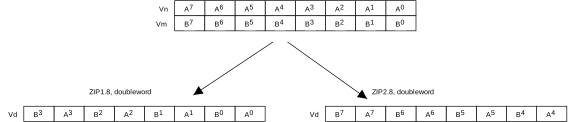
This instruction reads adjacent vector elements from the upper half of two source SIMD&FP registers as pairs, interleaves the pairs and places them into a vector, and writes the vector to the destination SIMD&FP register. The first pair from the first source register is placed into the two lowest vector elements, with subsequent pairs taken alternately from each source register.
This instruction can be used with ZIP1 to interleave two vectors.
The following figure shows an example of the operation of ZIP1 and ZIP2 with the arrangement specifier 8B.
Depending on the settings in the CPACR_EL1, CPTR_EL2, and CPTR_EL3 registers, and the current Security state and Exception level, an attempt to execute the instruction might be trapped.
| 31 | 30 | 29 | 28 | 27 | 26 | 25 | 24 | 23 | 22 | 21 | 20 | 19 | 18 | 17 | 16 | 15 | 14 | 13 | 12 | 11 | 10 | 9 | 8 | 7 | 6 | 5 | 4 | 3 | 2 | 1 | 0 |
| 0 | Q | 0 | 0 | 1 | 1 | 1 | 0 | size | 0 | Rm | 0 | 1 | 1 | 1 | 1 | 0 | Rn | Rd | |||||||||||||
| op | |||||||||||||||||||||||||||||||
if !IsFeatureImplemented(FEAT_AdvSIMD) then EndOfDecode(Decode_UNDEF); end; if size::Q == '110' then EndOfDecode(Decode_UNDEF); end; let d : integer{} = UInt(Rd); let n : integer{} = UInt(Rn); let m : integer{} = UInt(Rm); let esize : integer{} = 8 << UInt(size); let datasize : integer{} = 64 << UInt(Q); let elements : integer = datasize DIV esize; let part : integer = UInt(op); let pairs : integer = elements DIV 2;
| <Vd> |
Is the name of the SIMD&FP destination register, encoded in the "Rd" field. |
| <T> |
Is an arrangement specifier,
encoded in
|
| <Vn> |
Is the name of the first SIMD&FP source register, encoded in the "Rn" field. |
| <Vm> |
Is the name of the second SIMD&FP source register, encoded in the "Rm" field. |
AArch64_CheckFPAdvSIMDEnabled(); let operand1 : bits(datasize) = V{}(n); let operand2 : bits(datasize) = V{}(m); var result : bits(datasize); let base : integer = part * pairs; for p = 0 to pairs-1 do result[(2*p+0)*:esize] = operand1[(base+p)*:esize]; result[(2*p+1)*:esize] = operand2[(base+p)*:esize]; end; V{datasize}(d) = result;
This instruction is a data-independent-time instruction as described in About PSTATE.DIT.
2026-03_rel 2026-03-26 20:48:11
Copyright © 2010-2026 Arm Limited or its affiliates. All rights reserved. This document is Non-Confidential.